People
Revival of the Hakka Qilin Dance in Singapore
Revival of the Hakka Qilin Dance in Singapore
Volume 56 · September 2023
Volume 56 · September 2023
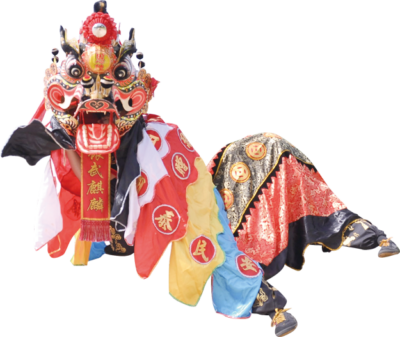
Could it be possible in a small city-state such as Singapore with a large ethnic Chinese population who have a hyper-awareness of Chinese culture that a larger-than-life, colorful, loud, mythical, yet very real creature has been hiding in plain sight for years? Enter the qilin 麒麟. Confucius penned his last words in the unfinished historical chronicle Spring and Autumn Annals (春秋, 770–476 BCE), with a simple yet profound line noting the qilin’s demise.¹ The qilin, or keilun, is a mystical beast, a unicorn with similar bearings to that of the turtle, phoenix, and dragon with its lineage tracing back to 2697 BCE.² It is sometimes argued that the qilin might not be a unicorn as it has two horns, though it is depicted with one horn in the case of a Hakka qilin dance head. Scholars Jing Fang (77–37 BCE)³ and Zhu Xi (1130–1200) have described the qilin as having five colors, scales covering its deer-shaped body, the head of a dragon, the tail of an ox, and bearing its weight on four goat-like hooves. The head frame of the qilin dance we see now is similar to that of the Dongguan style found in Hong Kong. The forehead protrudes, the structure is tilted forward, and the features are rather prominent. There is a sharp curved horn at the back of the head pointing forward, the eyes, ears, and corners of the face are painted with bright, colorful patterns, and three sharp horns are arranged vertically down the back of the head.⁴
Please introduce your community briefly. The Hakka qilin dance is a sacred ritual and a cultural heritage of the Hakka people—the fourth-largest Chinese dialect group in Singapore, numbering around 259,000, or about 8.6% of its Chinese population.⁵ In the past, the qilin dance was a display of martial arts, fitness, and entertainment, seen regularly in religious ceremonies. Today, dance plays an important role in tradition: it not only unites and maintains relationships but the atmosphere generated helps reaffirm the identity of the Hakka people at home and abroad. The Hakka qilin dance has roots in the Qianlong period (1736–95) of the Qing Dynasty. Historically, the Hakka people were a nomadic tribe in China that consisted of mostly hardworking farmers. The qilin dance was adopted as a cleansing ritual for their dwellings as well as to ward off any evil entities that might plague the village. The dance was also performed to pray for and celebrate a bountiful harvest and mild weather. 國泰民安, 風調雨順 can sometimes be seen painted on the qilin, echoing the sentiments of praying for world peace and weather beneficial for agriculture. Traces of the Hakka lion in Singapore can be found dating back only to 1983, and it slowly disappeared by the 1990s.⁶
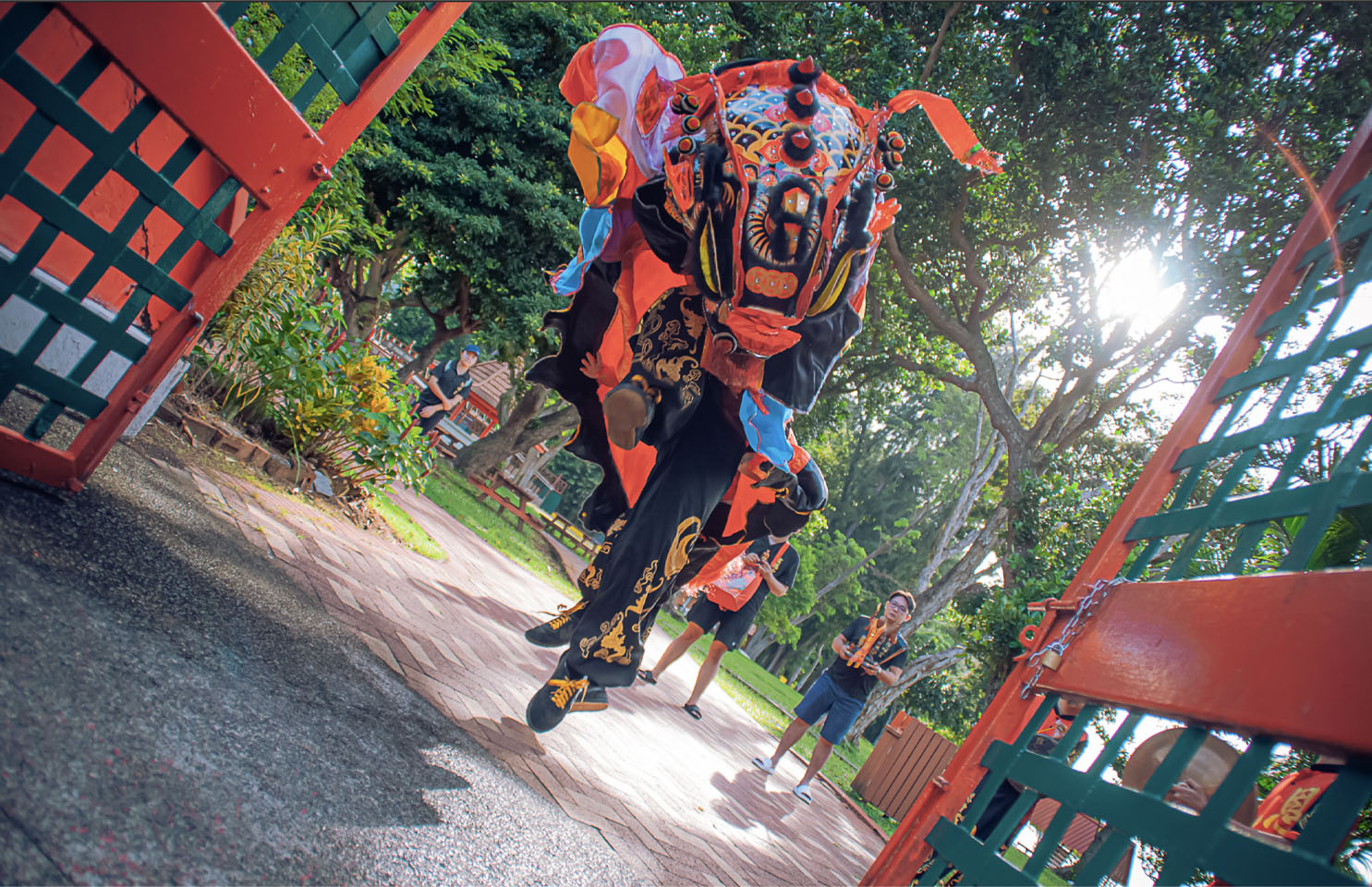
How does it influence Singapore society and what changes did you see? It is common for Chinese lion dance troupes to be hired to perform during auspicious occasions such as the Lunar New Year or when seeking good fortune for a new business or home. A little-known fact is that the as qilin ranks above the lion in the hierarchy of martial dances. When a lion dance troupe encounters a qilin troupe during a performance, the lion dancers will bow as low as possible as a mark of deference to the qilin. The qilin dance is not widely practiced in Singapore with the exception of one or two organizations that understand its correct execution. Yan Wong Cultural Troupe Singapore (恩隍文化团新加), founded in March 2015, was one among the first such troupes practicing and upholding the integrity of the Hakka qilin dance. Through the work of Eugene Wan, who heads and coaches the troupe, we can understand the significance of the performance, the importance of preserving the qilin’s place in our culture, and the phenomenon of cultural motifs expressed in multiple facets of society. Eugene Wan and his team have seen an increase in requests for the Hakka qilin dance in Singapore and are working better to educate the masses on its intricacies.
Please explain the element that your community is practicing. The punchy bursts of movement and surges of energy depicted by the dance require hours of tough training. The qilin dance is different to that of the lion, who projects cat-like movements. The lower bearing in this striking dance shows the achievement and ability of the troupe’s training and strength.
How did you decide to transmit the element? Was there a specific moment or did the desire just gradually develop? Personally, I was drawn to the dance through my broader interest in the rich heritage of cultural practices and artisanal skills which exist in Singapore but are at risk of being lost. Eugene Wan believes that by guiding his students through to mastery of the discipline via repetition and refinement, they will be taken on a journey that will teach them many life lessons. The reason the Hakka qilin dance is not widely practiced in Singapore is the lack of awareness, and the interest in maintaining troupes has dwindled, training is difficult, and recruitment of dedicated members is difficult, as well as the harsh reality of securing regular income. The Hakka people are also rather conservative in character and do not easily share skills with outsiders, making it difficult for the wider world to find a connection to the dance.
I am curious about the lessons you learned while you practiced the dance and how you feel about it. A qilin performance requires two dancers and a percussion ensemble of three, comprising a gong 高边锣, a pair of large cymbals 广钹, and a small drum 小战鼓. Sometimes, a special drum, 师公鼓, literally “master’s drum,” will be used.
It represents the masters of the past, and is said to contain the energy of these past masters. The heart and soul of the dance is a pair of cymbals, 45 cm in diameter, much bigger than the 30 cm cymbals used in the lion dance.
Do you have any final message? The Hakka qilin dance is a cultural performance facing extinction in Singapore for the second time in modern history. For the Hakka people, the qilin evokes both spiritualism and rituals close to the heart. It is a performance that wards off evil, purifies, renews, and prays for blessings. When the public can recognize the qilin in settings such as films and corporate branding, there is hope that enough interest will persist to keep the legend alive for many years to come.
NOTES
1. Dong Zhongshu, Luxuriant Gems of the Spring and Autumn (New York: Columbia University Press, 2015), pp. 159–62.
2. Brian Duignan, “Qilin,” Encyclopedia Britannica, 2 February 2023, https://www.britannica.com/topic/qilin.
3. Heng Chuan, Mao, Zheng Xuan Jian, and Deng Zhu, 宋本毛诗诂训传(共3册)/国学基本典籍丛刊, vol. 1 (Beijing: Beijing Commercial Press, 1935), 76. Study of Chinese Classic Series.
4. 劉繼堯 and 袁展聰, 武舞民間─香港客家麒麟研究 [A study of the Hakka Qilin dance in Hong Kong—A folk martial dance] (Hong Kong: 商務(香港)印書館, 2018), 29.
5. Singapore Department of Statistics, Census of Population 2020 (Singapore: Author, 2020), 39, 48.
6. Keow Min Lion Dance Athletic Society, Keow Min Lion Dance Athletic Society 35th anniversary souvenir magazine 侨民国术舞狮团成立卅五周年纪念特刊. (1983).