People
TORAJAMELO: Weaving a Brighter Future for Indonesian Artisans
TORAJAMELO: Weaving a Brighter Future for Indonesian Artisans
Volume 62 · March 2025
Volume 62 · March 2025
Bhimanto Suwastoyo
Community Collaboration Coordinator, TORAJAMELO, Indonesia
On Samosir, an island in Indonesia’s scenic Lake Toba, Henny Sagala, a mother of three is diligently trying out various leaves, roots and barks she could find in her village to produce a wide range of natural colors for her Ulos and Songkets (local traditional cloths).
“Together with a group of other women weavers from my clan we have even registered a new natural dye from the bark of the Jior tree (Senna siamea) at the patent office,” Henny said proudly.
Henny is one of the few weavers in the village of Lumban Suhi-Suhi Toruan who has been using traditional natural dyes for her backstrap loom weavings. However, but a training she received in June 2024 made her even more interested in developing new colors from plants she could find in her villages.
Lumban Suhi-Suhi Toruan is one of the many rural communities across Indonesia that has received training by TORAJAMELO, a social enterprise aimed at helping to empower women by strengthening their weaving traditions while making them also more in tune with modern tastes and needs.
For TORAJAMELO, it all started years ago in the heart of the mountainous Toraja highland, where a vibrant tradition of handwoven textiles was slowly fading away.
Faced with limited economic opportunities, particularly for women, many villagers were leaving their homes in search of work abroad, often leaving families behind. TORAJAMELO was founded in 2008 to address this very issue, breathing new life into the local economy by revitalizing this cherished art form.
The challenge was twofold: the decline of traditional weaving, overshadowed by mass-produced clothing and the rise in popularity of Batik, and the lack of income-generating opportunities for women in rural Toraja. TORAJAMELO saw an opportunity to kill two birds with one stone, addressing both problems simultaneously, using weaving as the cornerstone of its efforts. Our vision: to create a brighter future for weavers while preserving and celebrating Indonesia’s rich textile heritage.
As a social enterprise, TORAJAMELO recognizes the interconnectedness of cultural, social, and environmental sustainability. We believe that true progress can only be achieved through a holistic approach. By 2010, we had solidified our structure as both a Foundation and a Limited Liability Company, driven by three core principles: Commerce, Community Collaboration, and Consultancy.
Aligned with the United Nations Sustainable Development Goals (SDGs) – No. 1 (No Poverty), No. 5 (Gender Equality), No. 12 (Responsible Consumption & Production), and No. 13 (Climate Action) – TORAJAMELO has already partnered with over 1,500 weavers across Indonesia. Our work is ongoing, with plans to expand their reach to more weavers in ten communities across diverse regions, including North Sumatra, Kalimantan, Sulawesi, Timor, Papua, Sumba, and Flores.
TORAJAMELO’s impact extends beyond economic empowerment. We are not just preserving a cultural heritage; we are fostering independence and promoting sustainable development. As one of the few UNESCO-accredited Indonesian NGOs, TORAJAMELO actively supports efforts to include Indonesian intangible cultural heritage on the UNESCO list.
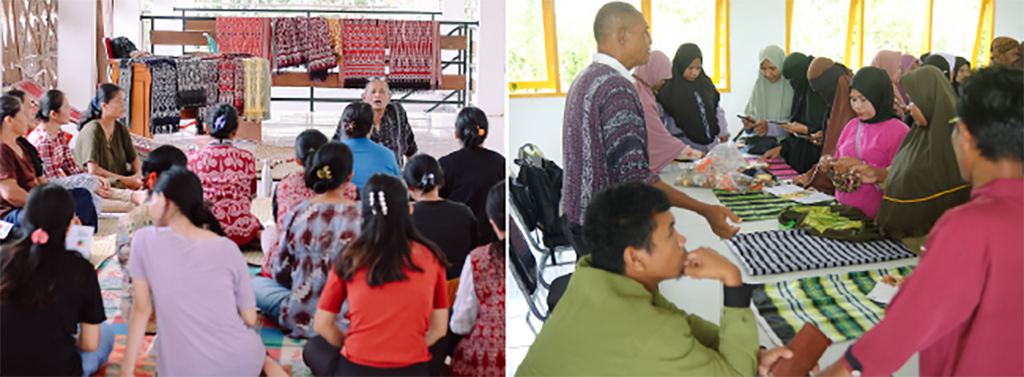
Within Indonesia, TORAJAMELO provides invaluable training to weaving communities nationwide. These programs focus on improving access to wider markets (both domestic and international), enhancing business management skills (including financial literacy), and ultimately improving the weavers’ livelihoods.
Although the training programs are tailored to local needs, they usually all cover a range of crucial areas:
Product Development
Weavers learn to create high-quality, marketable products, incorporating modern color combinations while preserving traditional techniques. This blend of tradition and contemporary design increases their products’ appeal and competitiveness.
Market Trends
Understanding current market preferences empowers weavers to create products that resonate with consumers, leading to increased demand and better pricing.
Online Marketing
Weavers gain the skills to reach a broader audience and build their brand through online platforms, expanding their market reach significantly.
Bhimanto Suwastoyo
Community Collaboration Coordinator, TORAJAMELO, Indonesia
Financial Literacy
Training in basic financial management empowers weavers to manage their finances effectively, ensuring the sustainability of their businesses and opening doors to financial services like loans.
These training initiatives have a profound impact, boosting the economic prospects of traditional weavers and contributing to the revitalization of Indonesia’s textile heritage. At the very least, the training built or reinforced awareness of the importance of maintaining traditional weaving as a cultural heritage while at the same time taking into consideration the taste and needs of the modern world.
Lamria Sitorus, a weaver in Lumban Suhi-Suhi Toruan, said that the three day-training provided by TORAJAMELO she underwent in 2024 had opened her eyes that not only dyes could be made from roots, leaves or bark of plants that were easily available in her village but that maintaining quality of her weaving was really important.
“I now make sure that my weaving is of the highest quality. This opens up so many possibilities to make my Ulos more attractive and saleable,” said Lamria.
In Ensaid Panjang, a village in West Kalimantan’s Sintang district, housewife Yudit Lukan said that after taking part in a three-day training by TORAJAMELO in August 2024, she was now optimistic that she could widen the market for her weaving by going online.
“The Internet is not stable here but at least I can go to the office of the head of the village to put pictures of my weaving online, so that I can sell more and not only depend on visiting tourists,” Yudit said. Her village has one of the few surviving traditional longhouses in the area and is a popular local tourist destination.
Economic gain from weaving was not the only thing that the weavers were made aware of. Senior high school student Lidia Mariska, who is an apprentice weaver in Lumban Suhi- Suhi Toruan said that the training made her realize what she really wanted to do. “I want to teach children about the importance of conserving customs, especially our weaving tradition.”
TORAJAMELO’s commitment to empowering rural women and helping to conserve traditional backstrap loom weaving as a priceless intangible cultural heritage is unwavering. We continue our journey with the support of our partners and the communities we serve, weaving a brighter future for Indonesian artisans.